





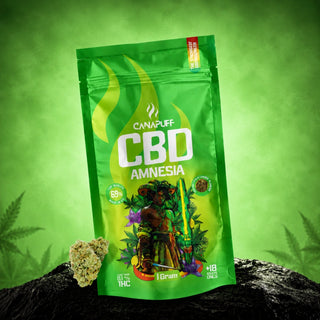
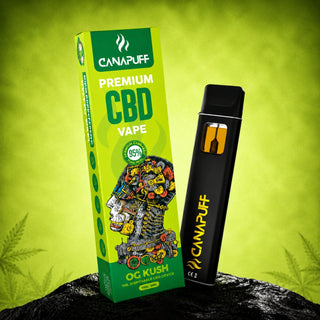
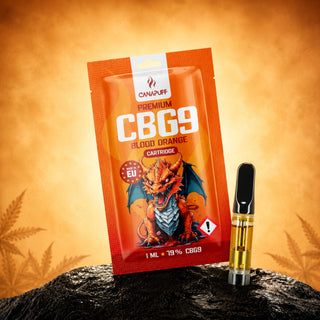


Yes, THCP (tetrahydrocannabiphorol) is psychoactive. In laboratory tests it bound to the CB1 receptor about 33 times more strongly than THC, and in mice it produced THC-like effects. What it does in people has never been tested in a controlled human study, so every statement about a "THCP high" comes from self-reports, not from research. What is known so far fits into three points: the receptor data, the animal data and the large gap in human data. Canapuff does not sell THCP.
Key facts
- THCP was first described in 2019 by an Italian research team (Citti et al., Scientific Reports).
- Its binding to the human CB1 receptor in vitro (Ki 1.2 nM) was close to that of the synthetic cannabinoid CP55940 (Ki 0.9 nM).
- The longer side chain (7 carbon atoms instead of 5 in THC) explains the stronger binding.
- We found no published controlled study of THCP in humans.
- Canapuff does not sell THCP.
Does THCP get you high?
THCP can get you high. The available research shows THC-like activity, and the strength of its receptor binding suggests that small amounts can have a strong effect. THCP belongs to the same group of cannabinoids as THC. Both act on the CB1 receptor, which is the receptor in the brain that is responsible for the typical cannabis high.
The key study comes from the University of Modena and Reggio Emilia. In 2019, Citti and colleagues isolated THCP from a cannabis variety and tested it in two ways:
- In vitro. THCP bound to the human CB1 receptor with a Ki value of 1.2 nM. A lower Ki means stronger binding. The value was close to that of CP55940, a synthetic cannabinoid that is used in research as a reference for a very strong CB1 activator.
- In mice. In the so-called cannabinoid tetrad test, THCP caused reduced movement, immobility, a lower body temperature and a reduced reaction to pain stimuli. These four signs are the standard way to identify THC-like activity in animals. The title of the study describes the activity in vivo as higher than that of THC.
The research stops there. We found no published clinical study that gave THCP to people under controlled conditions. That means there is no reliable data on how strong a THCP high is in humans, how long it lasts or which amount causes which effect.
Is THCP stronger than Delta 9 THC?
In laboratory tests THCP binds much more strongly to the CB1 receptor than Delta 9 THC, but "33 times stronger" is a receptor value, not a measured effect in people. The figure is often repeated in marketing. It describes how firmly the molecule attaches to the receptor in a test system. How strong a substance feels also depends on how much of it reaches the brain, how fast it is broken down and how the body adapts. None of this has been measured for THCP in humans.
| Delta 9 THC | THCP | |
|---|---|---|
| Full name | Δ9-tetrahydrocannabinol | Δ9-tetrahydrocannabiphorol |
| Side chain | 5 carbon atoms (pentyl) | 7 carbon atoms (heptyl) |
| Known since | 1964 | 2019 |
| Natural amount in cannabis | Main psychoactive cannabinoid | Trace amounts |
| CB1 binding in the lab | Strong | Much stronger, close to CP55940 |
| Controlled human studies | Many | None published |
| Sold by Canapuff | Yes, for example THC vapes and edibles | No |
The connection between side chain length and activity was known long before THCP was found. A review by Bow and Rimoldi (2016) describes how classical cannabinoids with longer side chains bind more strongly to CB1. THCP is the first such compound with a seven-carbon chain that was identified in the plant itself. A detailed comparison with THC, including the claims around the "33 times" figure, is in our article THCP vs THC.
What does a THCP high feel like?
There is no scientific description of a THCP high, only self-reports, and they cannot be checked. People who describe THCP experiences online usually compare it with THC and report a stronger and longer effect than they expected. They also report more unwanted effects. Self-reports have clear limits: nobody knows what was really in the product, how much was used and whether other substances were involved.
What can be said with more certainty: if THCP acts like THC at the CB1 receptor, it can also cause the known unwanted effects of THC. The U.S. National Institute on Drug Abuse (NIDA) lists anxiety, fear, distrust and panic among them, and notes that they are more common with large amounts and strong products. A very potent compound makes it easier to take too much by mistake.


How long does a THCP high last?
Nobody knows exactly, because the duration of THCP effects has never been measured in humans. Figures that appear on websites, such as a certain number of hours, are not based on published studies. They come from user reports or are copied between websites.
For drug tests the situation is similar. THCP is chemically close to THC, but standard tests are designed for THC metabolites. Whether and how long THCP is detected depends on the test. Our article THCP drug test: can I still drive? covers the topic. Do not drive or operate machines after using any cannabinoid that affects the CB1 receptor.
Is THCP natural or synthetic?
THCP occurs naturally in cannabis, but only in trace amounts, so products sold as THCP were made in a laboratory. The research team that discovered it found THCP in a specific cannabis variety in very small concentrations. Extracting enough THCP from plants for commercial products is not practical. THCP products on the market were therefore made by chemical conversion of other cannabinoids, usually from hemp.
This also matters for quality. In semi-synthetic production, by-products and leftover reagents can remain in the product if it is not cleaned and tested properly. Many of these products were sold without reliable lab reports.
Is THCP legal?
The legal status of THCP depends on the country, and several European countries have restricted semi-synthetic cannabinoids in recent years. The rules change often and some laws cover whole groups of substances instead of single names. That makes a simple yes or no answer for Europe impossible. Check the current law in your country before you buy or use any cannabinoid product.
Our guide what is THCP summarises the legal situation and explains why Canapuff has removed THCP from its range.

Alternatives to THCP at Canapuff
Canapuff does not sell THCP and offers other cannabinoids instead, with the cannabinoid and percentage in every product name. The former THCP lines were replaced by:
- THP420 products, a cannabinoid developed by Canapuff, as THP420 flowers and THP420 vapes.
- THCA products. Raw THCA does not cause a high. When heated, it turns into THC. Our guide does THCA get you high explains the process.
- THCv products, a smaller line with vapes, cartridges and flowers.
Rules for these products also differ between countries. Read the product page and the certificate of analysis (COA), and check what applies where you live.


Sources
- Citti, C. et al. (2019). A novel phytocannabinoid isolated from Cannabis sativa L. with an in vivo cannabimimetic activity higher than Δ9-tetrahydrocannabinol: Δ9-tetrahydrocannabiphorol. Scientific Reports, 9, 20335. nature.com
- Bow, E. W. and Rimoldi, J. M. (2016). The structure-function relationships of classical cannabinoids: CB1/CB2 modulation. Perspectives in Medicinal Chemistry, 8, 17 to 39. PMC
- National Institute on Drug Abuse (2024). Cannabis (marijuana) DrugFacts. nida.nih.gov