





























Table of contents
- What is static hash ›
- How static hash is made with static electricity ›
- Static room hash and why the environment matters ›
- Static hash vs dry sift hash ›
- Static hash vs frozen hash ›
- Static hash vs bubble hash ›
- Is static hash made from WPFF or dried material ›
- How to recognise good static hash ›
- Is static hash legal in Europe ›
Static hash is a dry sift concentrate in which trichome heads are separated from plant material using static electricity instead of water or fine screens alone. The resin is rubbed or agitated over a charged surface, often acrylic or glass, and the dry trichome heads transfer to that surface while leaf fragments and stalks remain. The result is a pale, sandy to blonde resin with very little green contamination. The term is a recent addition to dry sift vocabulary, used in the hash trade as shorthand for a very clean grade of sifted resin rather than for a separate plant or extraction technology.
Key facts
- Static hash is a solventless concentrate: no butane, no ethanol, no water bath.
- The separation relies on triboelectric charge, an electrostatic effect also used in industrial material sorting.
- Trichome heads are 50 to 120 micrometres wide, which is why they move while heavier plant fragments do not.
- Production rooms are kept cold and dry, often below 30 percent relative humidity, because moisture destroys the charge.
Whether a hash product may be sold or possessed depends on the cannabinoid it contains and on the country. Rules change often, so check the current status where you live before ordering.
What is static hash
Static hash is the trichome head fraction of dried cannabis, collected by exploiting the electrostatic charge difference between resin glands and plant matter. It sits inside the dry sift family, but it is a refinement step rather than a separate plant process. A sifter first produces regular kief or dry sift, then moves that material across a static-charged surface to separate the resin heads from the remaining vegetal dust.
The glandular trichome is the key. Each head is a small bulb of resin on a stalk, holding the cannabinoids and most of the terpenes. Our guide to trichomes explains the structure in detail. Those heads are smoother, rounder and lighter than broken leaf tissue, and they accept and hold a charge differently. That difference is what the method uses.
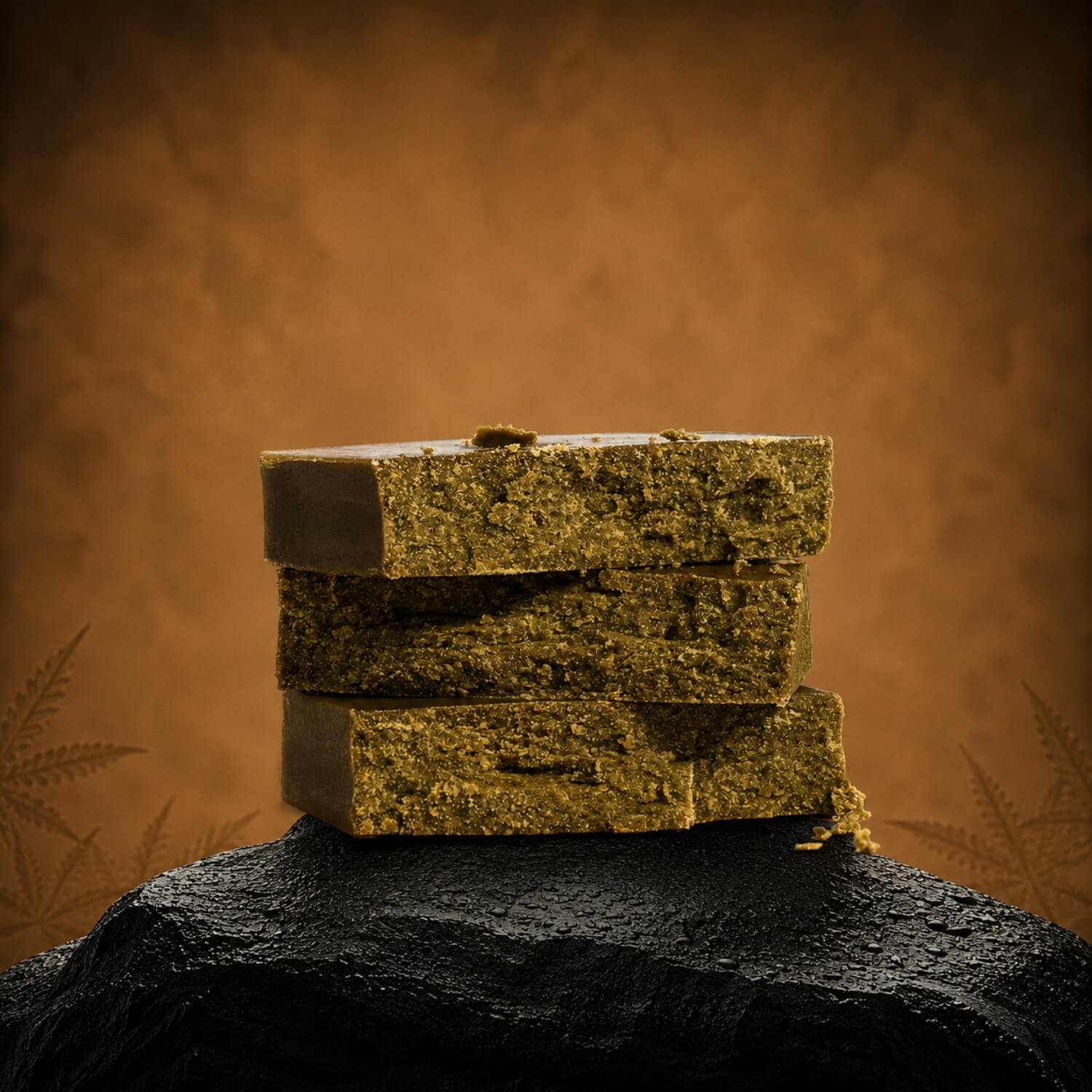
Visually, good static hash looks like fine blonde sand. Under a loupe it reads as a field of translucent spheres rather than a mix of green specks and resin. When pressed between fingers it darkens and becomes pliable, because the heads rupture and the resin binds.
How static hash is made with static electricity
The production relies on the triboelectric effect: two different materials rubbed against each other exchange electrons, and one surface becomes negatively charged. An acrylic or polycarbonate sheet charged by friction, or a cold glass pane in a dry room, attracts the dry trichome heads from a thin layer of sifted material. The heads lift and transfer, the heavier fibre and leaf dust remain.
Humidity is the first limit. Moisture in the air drains the charge within seconds, which is why producers work at low relative humidity and why the method fails in a warm workshop. Cold matters for a different reason: brittle resin heads detach from the stalks cleanly, while warm resin smears. The starting material also has to be partly refined already, since raw ground flower carries far too much plant mass for the charge to separate anything useful.
We are not writing a step by step recipe here. If you want the practical side, the full breakdown of screens, bags, pressing and temperature sits in our article how to make hash: bubble hash, dry sift, rosin and charas. What matters for the buyer is the consequence of the method: fewer contaminants, a lighter colour and a flavour that stays closer to the living plant, because no water and no heat pass through the resin.
Static room hash and why the environment matters
A static room is a dedicated cold, dry space where the whole sifting process happens, and it is the reason the best static hash is consistent rather than lucky. Producers run these rooms at low relative humidity, often under 30 percent, and at temperatures near or below freezing. Some work inside walk in freezers, some use conditioned rooms with dehumidifiers.
The payoff is repeatability. In a humid workshop the charge dissipates within seconds and the trichomes clump instead of migrating. In a controlled room the same batch of material behaves the same way every time, which is what separates a craft product from a single experiment.
Static rooms also reduce contamination from a second direction. Cold, dry air slows terpene loss and limits microbial activity on the resin. That is part of why static hash often smells sharper and more specific to the strain than hash that has been handled warm.
Colour alone is not proof of quality. A pale product can still come from poorly stored flower, so look for a certificate of analysis and a clear statement of which cannabinoid the product contains.



Static hash vs dry sift hash
All static hash is dry sift, but not all dry sift is static hash: the static step is an extra purification that removes plant material a screen cannot catch. Classic dry sift uses a series of mesh screens, usually from 220 down to 70 micrometres, and sorts by particle size. Anything the same size as a trichome head passes through with it, including broken leaf edges and cuticle fragments.
Static separation sorts by material property instead of size. That is why a sifter can take a 73 micrometre dry sift that already looks good and refine it to a visibly cleaner grade. In the trade, full melt dry sift is graded from one to six stars, and static work is one of the ways producers reach the upper grades.
The Canapuff Dry Sift Hash and Semi Dry Hash show the two ends of that spectrum well. Dry sift is loose and powdery, semi dry has been worked slightly so it holds together and feels closer to a traditional pressed hash.
| Property | Classic dry sift | Static hash |
|---|---|---|
| Separation principle | Particle size through mesh | Electrostatic charge difference |
| Typical colour | Light green to blonde | Blonde to near white |
| Plant material left | Low to moderate | Very low |
| Water used | None | None |
| Yield from same input | Higher | Lower, because the standard is stricter |
Static hash vs frozen hash
Frozen hash describes the state of the starting material, static hash describes the separation method, so the two overlap rather than compete. Fresh frozen plants are harvested and placed into freezing immediately, without drying and curing. That preserves volatile terpenes that would otherwise evaporate over a two week dry.
Most fresh frozen material goes into water extraction, because ice water handles wet biomass well. Static separation needs dry, brittle resin, so a producer working with frozen input has to dry it under cold, controlled conditions first. That is possible, and some of the most aromatic static hash on the market starts that way, but it is slower and the yield is lower.
The practical difference for the consumer is aroma versus clarity. Fresh frozen routes keep more of the loud, fruity top notes. Static routes give a cleaner burn and less residue. Our article on frozen hash and live rosin covers the fresh frozen side in more depth.
Static hash vs bubble hash
Bubble hash separates trichomes with ice water and mesh bags, static hash does it dry with charge, and the two produce clearly different textures. In the ice water method, agitation detaches the resin heads and they sink through a stack of bags, usually from 220 down to 25 micrometres. The wet resin is then dried, which takes days and is the stage where quality is most often lost.
Water contact is the dividing line. It is efficient and it scales, but it can strip some water soluble compounds and it introduces a drying step with a real risk of mould if done badly. Static hash never touches water, so the drying problem does not exist. In exchange, static work is harder to scale and demands a controlled room.
- Texture: bubble hash ranges from sandy to a melt that bubbles on heat; static hash is dry and powdery until pressed.
- Equipment: bubble needs bags, ice and a washing vessel; static needs a cold dry room and charged surfaces.
- Risk point: bubble hash fails during drying; static hash fails when humidity rises.
- Flavour: both can be excellent, with static often reading drier and more resinous, bubble fuller and sweeter.
Ice-O-Lator is the best known name for the bag based version of that process, and hash rosin is what happens when either style of hash is pressed under heat.
Is static hash made from WPFF or dried material
Static hash is almost always made from cured, dried material, because whole plant fresh frozen biomass contains too much water for an electrostatic process. WPFF stands for whole plant fresh frozen: the entire plant, buds and sugar leaves together, frozen directly after cutting. Water in that material keeps the trichome heads soft and conductive, and soft heads smear instead of transferring.
There is a middle route. Some producers freeze fresh material, then freeze dry it in a lyophiliser, which removes water at low temperature without the heat of a normal dry. The result behaves like dried material under static but keeps much of the fresh frozen terpene profile. This is expensive, and products made this way are usually labelled clearly.
So when a label says static hash, the sensible assumption is cured input, sifted dry, refined with charge. If a producer claims fresh frozen static hash, ask whether the material was freeze dried, since that is the only route that makes technical sense.
How to recognise good static hash
Judge static hash by four things: colour, grain, melt behaviour and smell, in that order. Colour should be blonde to off white with no green cast. A grey or olive tint means plant material came through. A very dark brown colour means the product was either oxidised or pressed warm, which is not automatically bad but is no longer a clean static grade.
Grain and texture
Under magnification you want to see intact spheres, not a dust of broken shells. Loose static hash should pour. If it clumps at room temperature without being pressed, the heads have already ruptured or moisture is present.
Melt and residue
High grade sift melts rather than burns. Placed on a hot surface it should bubble and reduce to a small amount of clear to amber oil. A thick black carbon ring is a sign of plant contamination. This test is also the fastest way to compare two products from different producers.
Aroma and labelling
Smell should be specific: pine, citrus, pepper, diesel, depending on the strain. A flat hay smell suggests old or badly stored material. On the label, check which cannabinoid is declared and at what percentage, and look for a certificate of analysis you can actually read.
Canapuff carries several products in this family. La Mousse Hash is the airy, light pressed style, Semi Dry Hash sits between loose sift and a pressed block, and the THCA hash range appears in flavours such as Afghan Gold, Libanese, Choco and Banana. The full hash collection also includes CBD hash for anyone who wants the format without a strong psychoactive cannabinoid. If you are unsure which format suits you, the Canapuff product finder narrows it down in a few questions.


Is static hash legal in Europe
Legality depends on the cannabinoid the product contains and on the country, not on the fact that it was made with static electricity. The separation method is simply a mechanical process. What national law looks at is the active compound declared on the label and the limits that apply to it, and those limits differ between European countries and have shifted several times in recent years.
This matters because the word hash now covers everything from traditional pressed import resin to craft solventless concentrates. Product names are not regulated. Two items sold as static hash can differ enormously in input quality, cannabinoid content and the care taken during processing.
Before ordering, check the current national rules for the specific cannabinoid named on the label, because a product that is sold openly in one country may not be permitted in another. For primary sources, see the European Union Drugs Agency, which reports on cannabis resin potency and product diversity in Europe, and EUR-Lex for the text of EU legislation. Research on trichome structure and cannabinoid distribution is summarised in Livingston et al., 2020, The Plant Journal, which mapped the glandular trichome types responsible for most resin production.