











Table of contents
What Is THCP? Potency, Effects, Legality and Buying Guide 2026
THCP, short for tetrahydrocannabiphorol, binds to the CB1 receptor in the human endocannabinoid system with 33 times the affinity of conventional delta-9-THC. That single figure, published in 2019 by a team at the University of Modena led by Giuseppe Cannazza in Scientific Reports (Nature), is why THCP attracts so much attention from researchers and consumers alike. A cannabinoid that occurs naturally in the cannabis plant, at concentrations below 0.1%, it was unknown until that study. This guide covers what the science says, how its potency translates in practice, what the legal situation looks like in Germany, Switzerland and Austria in 2026, and what to check before you buy.
What Is THCP?
THCP is a phytocannabinoid, meaning it is produced by the cannabis plant rather than synthesised in a laboratory. Like THC, CBD and CBG, it forms through the plant's natural biosynthesis pathway. The compound was identified in 2019 when Italian researchers at the University of Modena and Reggio Emilia analysed an Italian medical cannabis variety using liquid chromatography combined with high-resolution mass spectrometry. The team, led by Giuseppe Cannazza, published their findings in the peer-reviewed journal Scientific Reports, part of the Nature portfolio.
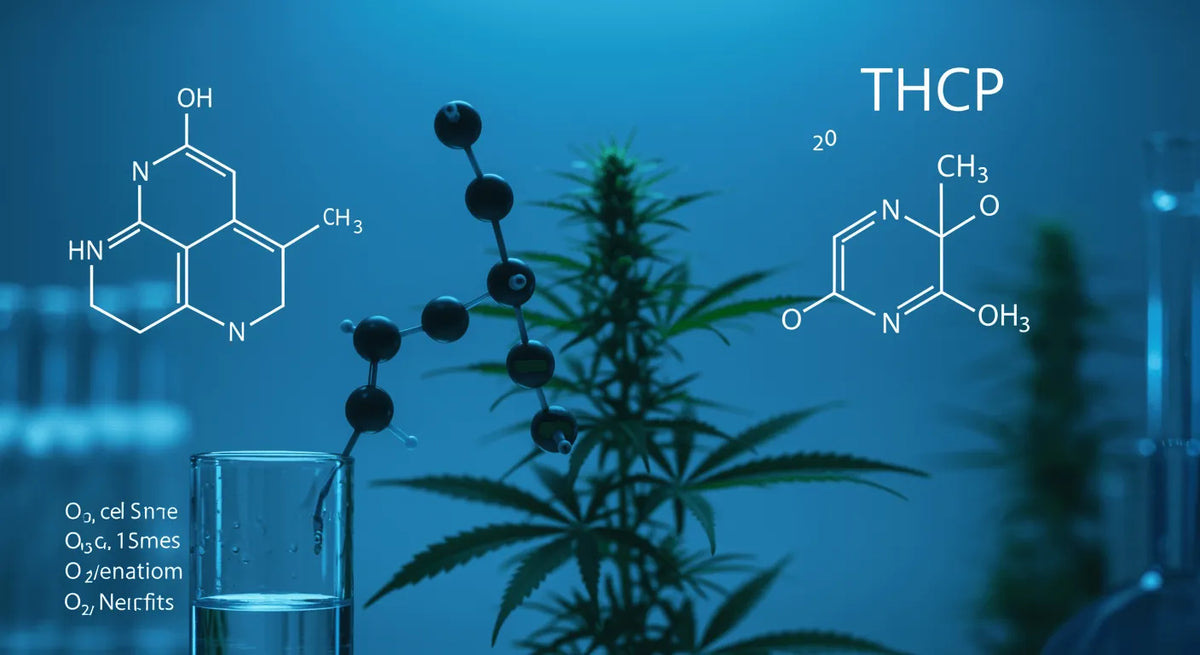
Structurally, THCP belongs to the same cannabinoid family as THC. Both molecules share a core ring system and interact with the same cannabinoid receptors. The difference lies in the side chain attached to that core. THC carries a pentyl side chain with five carbon atoms. THCP carries a heptyl side chain with seven carbon atoms. Two additional carbons alter how deeply and how firmly the molecule anchors into the CB1 receptor binding pocket.
In pharmacological terms, this structural difference produces a binding affinity for CB1 that is approximately 33 times higher than delta-9-THC. The Modena team measured a Ki value of 1.2 nM for THCP, compared to 5.05 nM for THC. A lower Ki indicates stronger binding: the receptor requires far less THCP to become occupied. In animal models used in the original study, THCP produced measurable cannabimimetic activity at doses as low as 0.1 mg per kilogram of body weight, lower than any naturally occurring cannabinoid tested at the time.
Because THCP appears naturally in cannabis at concentrations below 0.1% by weight, extracting it in commercially meaningful quantities from raw plant material is not economically viable. Most commercial THCP today is produced one of two ways: extraction and concentration from cannabis varieties selectively bred for elevated THCP content, or enzymatic and chemical conversion of hemp-derived CBD. The second route accounts for most of the supply reaching European consumers.
For a broader overview of the THC cannabinoid family and how different compounds compare, see our THC guide.
Potency vs THC
The 33x figure requires context. Receptor binding affinity describes how firmly a molecule locks onto its target receptor in a controlled laboratory setting. It does not describe the subjective experience one-to-one. Potency in practice depends on absorption, metabolism, the density and distribution of receptors across brain regions, and individual variation in the endocannabinoid system.
The binding data has clear practical implications for dosing. Users switching from THC products to THCP products report noticeable effects at significantly smaller quantities. Where a THC user might require 5 to 20 mg for a given effect, reported THCP doses that produce comparable effects tend to fall in the 1 to 5 mg range. Some experienced users report relevant effects from 0.5 mg.
| Cannabinoid | CB1 Binding (Ki) | Typical dose | Relative potency |
|---|---|---|---|
| THCP | 1.2 nM | 0.5 – 5 mg | ~33x THC |
| Delta-9-THC | 5.05 nM | 5 – 20 mg | Reference |
| THCA | Inactive (unheated) | N/A | 0 (before decarb) |
| CBD | Low affinity | 10 – 50 mg | Non-psychoactive |
The mechanism matters here. CB1 receptors are concentrated in regions governing mood, memory, pain processing, appetite and motor function. A cannabinoid that binds with much higher affinity occupies those receptors more completely at lower concentrations. The functional result tends to be a more pronounced effect per milligram, longer receptor occupancy, and a steeper dose-response curve. The last point is practically important: the gap between "nothing" and "too much" is narrower with THCP than with THC.
THCP also activates CB2 receptors, which are distributed primarily in immune tissue and peripheral organs. The Modena study reported CB2 Ki of 10.3 nM, weaker than CB1 binding but still within the range associated with peripheral cannabinoid activity. The implications for anti-inflammatory pathways are a subject of ongoing research and are not yet clinically characterised.
Cannabis produces both THCP and its corresponding acid precursor, THCPA. Like THCA with THC, THCPA must be decarboxylated by heat before it becomes active. Raw or unheated products may contain THCPA rather than THCP; the active content depends on how the product was processed.
Effects and Onset
The effects described by THCP users overlap substantially with those of high-potency THC: euphoria, physical relaxation, sedation, altered sensory perception and appetite stimulation. Because THCP is still a recent discovery, the available human evidence comes from user reports and from extrapolation of the preclinical data rather than from controlled clinical trials.
Onset time follows the same pharmacokinetic logic that applies to other cannabinoids:
| Method | Onset | Peak | Duration |
|---|---|---|---|
| Inhalation (vape) | 5 – 15 min | 30 – 60 min | 3 – 4 hours |
| Oral (edibles, oils) | 45 – 120 min | 2 – 3 hours | 6 – 8 hours |
| Sublingual (tincture) | 15 – 30 min | 60 – 90 min | 4 – 6 hours |
The extended duration with oral THCP is consistent with the compound's stronger receptor binding. Slower dissociation from CB1 means the effect persists after plasma concentrations have begun to fall.
For new users, the standard recommendation applied to high-potency cannabinoids applies here with greater urgency: start at 0.5 to 1 mg, use the oral route first to allow accurate dosing, and wait for the full onset window before considering whether to take more. Redosing before onset is complete is the most common source of overconsumption with oral cannabinoids generally, and the risk is amplified with THCP given its potency.
Reported adverse effects at higher doses mirror those of high-dose THC: anxiety, tachycardia, short-term memory disruption, and disorientation. There are no published reports of fatal toxicity in humans from THCP specifically. As with THC, users with a personal or family history of psychotic disorders should exercise caution or avoid the compound entirely.
Legality 2026
The legal status of THCP in Europe in 2026 is not uniform, and the situation continues to evolve. The following is an informational summary, not legal advice. Anyone buying, selling or transporting THCP should verify the current status under the law of their specific jurisdiction before doing so.
Germany. The Cannabis Act (CanG), which came into force in April 2024, legalised the possession and private cultivation of delta-9-THC for adults under specific conditions. It did not address THCP. As of early 2026, THCP does not appear by name on the schedules of the Narcotics Act (BtMG) or the New Psychoactive Substances Act (NpSG). This places it in a regulatory grey area rather than a clearly permitted or clearly prohibited category. The NpSG's analogue clause is broad and has been applied to novel cannabinoids before. Legal status in Germany must be regarded as uncertain and subject to change without notice.
Netherlands. As of 28 January 2026, THCP was explicitly added to List I of the Dutch Opium Act, the most restrictive schedule, alongside heroin and MDMA. THCP is not legally available in the Netherlands.
Switzerland. Switzerland operates a separate regulatory framework from the EU. Hemp-derived cannabinoids exist in a framework governed by the Therapeutic Products Act and the Narcotics Act (BetmG). Delta-9-THC is controlled; the status of THCP is not settled in published guidance as of early 2026. Swiss buyers should check the current guidance from Swissmedic before purchasing.
Austria. Austria schedules psychoactive substances primarily under the NPSG, which contains an analogue clause covering structurally related compounds. THCP's legal status in Austria should be verified with current Austrian regulatory sources before purchase.
Novel cannabinoids with high CB1 potency have consistently attracted regulatory attention within 12 to 24 months of reaching retail markets across Europe. The Dutch decision in January 2026 to explicitly name THCP in a national schedule is an indicator that regulators are tracking the compound. Buyers should treat the current legal status as provisional.
How to Buy
The absence of a harmonised EU regulatory framework for THCP means that product quality varies significantly between suppliers. Several indicators separate responsible products from those that present a higher risk.
Certificate of Analysis (CoA). Any legitimate THCP product should be accompanied by a CoA issued by an accredited third-party laboratory, not a laboratory with a financial relationship to the brand. The CoA should include: cannabinoid profile with THCP potency confirmed and all other cannabinoids quantified, delta-9-THC content confirmed within applicable limits, residual solvents panel, pesticide screen, and heavy metals screen. A CoA that shows only cannabinoid content, without solvent, pesticide and metal panels, is insufficient.
Clear dosing information. Products should state the milligrams of THCP per serving, not just per container. Given that effective doses are in the 1 to 5 mg range for most users, a product that lists only total cannabinoid content without per-serving breakdown makes accurate dosing impossible.
Supply chain transparency. Responsible suppliers can describe the origin of their hemp, the conversion or extraction process used to produce THCP, and the intermediate steps in production. Vague claims about "natural" sourcing without verifiable detail are a warning sign.
No health claims. Regulatory frameworks in Germany and across the EU prohibit specific health or therapeutic claims on cannabinoid products that are not authorised medicines. Products that claim to treat, prevent or cure any medical condition are making statements that are neither legally permissible nor supported by the current evidence base for THCP.
Delta-9-THC within legal limits. In markets where hemp-derived products are sold legally, the delta-9-THC content must fall within the applicable threshold. Confirm this figure on the CoA, not only on the product label.
Browse our current range of verified THCP products: THCP collection.
FAQ
What does THCP stand for and how was it discovered?
THCP stands for tetrahydrocannabiphorol. It was discovered in 2019 by a research team at the University of Modena and Reggio Emilia in Italy, led by Giuseppe Cannazza. The team identified it while analysing the cannabinoid profile of an Italian medical cannabis variety using high-resolution mass spectrometry. Their findings were published in Scientific Reports, a peer-reviewed journal from the Nature portfolio.
Is THCP 33 times stronger than THC in practice?
The 33x figure refers to CB1 receptor binding affinity measured in laboratory conditions, not to subjective potency in a one-to-one sense. In practice, users consistently report stronger effects per milligram compared to THC, and effective doses are typically 1 to 5 mg versus 5 to 20 mg for THC. The dose-response curve is steeper, meaning that small dose increases produce larger effect changes. The 33x figure is a useful indicator of relative potency but should not be interpreted as meaning the experience is exactly 33 times more intense.
How long do THCP effects last?
Duration depends on the route of administration. Via inhalation, effects typically last 3 to 4 hours. Via oral administration (oils, edibles, capsules), effects are frequently reported to last 6 to 8 hours, longer than a comparable oral THC experience. The extended duration is consistent with THCP's stronger and slower-dissociating receptor binding.
What dose of THCP should a beginner start with?
New users should start at 0.5 to 1 mg and wait for the full onset window before evaluating the effect. For oral products, onset can take 45 to 120 minutes. Taking an additional dose before the first has fully taken effect is the most common cause of overconsumption. Starting low and adjusting slowly is the standard approach for any high-potency cannabinoid.
Is THCP legal in Germany in 2026?
THCP is not listed by name in Germany's BtMG or NpSG schedules as of early 2026. This places it in a grey area rather than a clearly permitted status. The CanG, which came into force in April 2024, addressed delta-9-THC but not novel cannabinoids such as THCP. The NpSG's analogue clause is broad. Legal status is uncertain and may change. This is informational only and not legal advice.
Where does commercial THCP come from?
THCP occurs naturally in cannabis at concentrations below 0.1% by weight, which is too low for direct extraction at commercial scale. Most commercial THCP is produced either from cannabis varieties bred for elevated THCP content or by converting hemp-derived CBD through enzymatic or chemical processes. The second method is more common. A reputable supplier will be able to describe which process their product uses and provide documentation from the manufacturing stage.
What should a THCP Certificate of Analysis include?
A complete CoA for a THCP product should include: a full cannabinoid profile with confirmed THCP potency, delta-9-THC content within applicable legal limits, a residual solvents panel, a pesticide screen, and a heavy metals screen. The CoA should be issued by an accredited third-party laboratory. A CoA that shows only cannabinoid content without solvent, pesticide and metal data provides incomplete safety information.